
Georgia Voter Lookup Fields
The Secretary of State's My Voter Page, often called MVP, is the first official channel for a voter registration search. It is meant for a voter checking a personal record, not for browsing everyone with the same surname. Four identity fields must agree with the registration system. That design keeps the public self-service page useful without turning it into an unrestricted name directory.
| Lookup field | Input | Required | How to enter it |
|---|---|---|---|
| First Initial | Text | Yes | Use the first initial on the registration |
| Last Name | Text | Yes | Use the registered surname |
| County | Dropdown | Yes | Choose one of Georgia's 159 counties |
| Date of Birth | Date | Yes | Used to match identity, not shown as public output |
| Submit/Login | Button | No | Opens the personalized page when fields match |
Try the former county as well as the current one after a move. A non-match may reflect spelling, a county change, or a record needing review. It does not prove that the person never registered. The county registrar is the fallback when MVP does not resolve the issue.
Georgia Registration Results Explained
A successful MVP match can return registration status, registered county, precinct, polling location, voting districts, absentee application or ballot status, and a personalized sample ballot. Contact links point back to the election officials who maintain the record. These results answer practical election questions, but they are not a copy of the statewide voter file.
The state also states that a voter who moves must notify the county registrar in writing or submit a new application. A precinct card is mailed through the county, though the card is not required to vote. If it has not arrived after three to four weeks, contact the local registrar rather than assuming registration failed.
The assigned image shows the official login surface. Open Georgia My Voter Page before viewing the captured form.
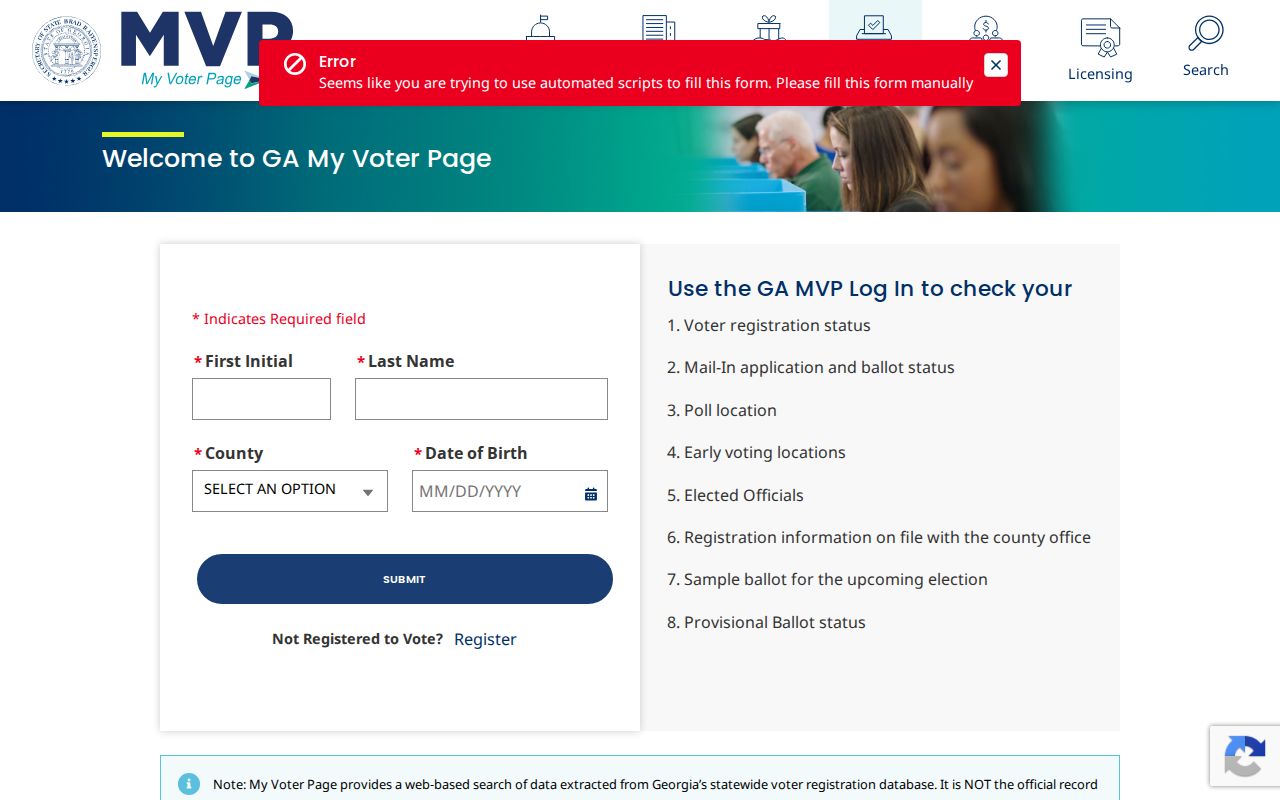
The visible fields reinforce the key distinction: MVP verifies a particular voter through supplied identity data rather than publishing an open surname search.
Note: Portal labels can change, so read the live field prompts before submitting a Georgia voter lookup.
What Georgia Voter Records Show
Georgia voter records serve different purposes depending on the product. A personalized MVP result is centered on current election logistics. An ordered elector list may include broader registration and participation fields. The exact bulk file can vary by the list type and geographic choices on the order.
| Name | May appear in a public elector list |
|---|---|
| Geography | Residence or mailing geography, county, municipality, precinct, and districts may appear |
| Status | Active or inactive, depending on the ordered list |
| Election History | Participation or date last voted, never the choices marked on a ballot |
| Party | Georgia has no permanent party-registration field |
| Contact and ID Data | Telephone, date of birth, Social Security number, and driver-license number are excluded by the official order form |
Confidential in Georgia. The official file omits the listed identity and contact fields, while Safe at Home procedures shield a participant's actual address. See O.C.G.A. §21-2-225 and the Georgia Safe at Home program.
Georgia Voting History Is Limited
Election participation history does not reveal a ballot choice. It can show that someone took part in an election and, depending on the file, a date-last-voted field. Ballots remain secret. Primary participation also does not create a permanent party affiliation because Georgia does not register voters by party.
This point prevents a common mistake. A primary-history entry may identify the type of primary in which a person participated, but it cannot establish every political view and does not show a vote for any candidate. Treat the field as an election-administration record, nothing more.
Order Georgia Voter Rolls
O.C.G.A. §21-2-225 makes elector lists available for inspection and copying under prescribed procedures. The Secretary of State's official voter-list order process supports a statewide voter file or a narrower list. A requester can choose active voters only or active and inactive voters, then describe counties, municipalities, districts, or precincts. Current pricing belongs on the live order page and should be checked before payment.
- Select the statewide file or define the desired list type and geographic area on the official order form.
- Complete customer and order details, then sign the certification acknowledging the statutory use warning.
- Send the required check or money order payable to the Secretary of State and retain the tracking information.
- Allow the stated normal production period of one to two weeks after payment, then import the delivered text file if a statewide order requires it.
Voter lists are supplied as CSV files, while the statewide file is described as text that must be imported into spreadsheet software. The form tracks date received, payment mailed, payment number, and amount. General access-law questions can be compared with the broader Georgia public records process, but the elector-list statute and order certification control this record set.
Two Georgia Voter Access Paths
MVP and an ordered voter file are not interchangeable. One answers a voter's immediate personal questions. The other supplies bulk public records under stated conditions.
| Access path | Best use | Gate | Output |
|---|---|---|---|
| My Voter Page | Confirm personal registration and election details | Initial, surname, county, birth date | Personalized status, polling, district, absentee, and ballot information |
| Voter-list order | Obtain a defined public elector list | Order choices, payment, signature, and certification | CSV or statewide text file with permitted fields |
| County registrar | Correct or clarify a local registration record | County procedure and identity checks | Record assistance, updates, precinct-card help, and local list answers |
The right channel depends on the task. Do not purchase a statewide snapshot to solve a personal polling-place problem, and do not expect MVP to export a county voter roll.
Georgia Voter Status Changes
Inactive does not mean cancelled. Georgia list maintenance can involve address-confirmation steps, returned mail, moves, reported deaths, felony sentences, duplicate records, and registrations in another state. Federal National Voter Registration Act rules also shape that process. A purchased file is a dated snapshot and should not be used to infer present eligibility without confirmation.
For corrections, address changes, or a missing precinct card, contact the county Board of Registrars. Georgia's statewide registrar locator routes users to the correct local office. Mail and direct contact remain essential access channels because each county administers its registrations even though MVP is statewide.
Note: Use the current MVP result and county registrar response before drawing any conclusion from an older Georgia voter file.
Georgia County Registrar Help
County Boards of Registrars are the local custodians behind the statewide system. They accept registration applications and changes, maintain elector records, issue precinct cards, and answer questions about county or municipal lists. Use the Georgia.gov county registrar locator to identify the correct office instead of sending a local correction to an unrelated state agency.
Contact methods vary by county. The documented fallback chain begins with MVP, continues to the county registrar by its published phone or office channel, and uses a written application or notice when an address changes. A person seeking a local elector list should ask that registrar about its inspection and copy procedure. Someone seeking the formal statewide product should use the Secretary of State order form.
Bring enough detail to separate similar records: registered name, former name if relevant, birth date for identity matching, prior county, present county, and the type of change needed. Do not send a Social Security number or driver-license number through an informal email merely because those fields are absent from the public file. Follow the office's secure instructions.
Georgia Voter File Use Limits
Georgia law draws a firm line around bulk elector data. O.C.G.A. §21-2-601 makes commercial use of a supplied elector list a misdemeanor, and the official order form prints that warning beside the certification. Never use a registration address or other locator information to stalk, threaten, or harass anyone. Georgia stalking and harassing-communications statutes can apply based on the conduct.
Use voter records lawfully. Keep ballot secrecy in view, follow the signed file certification, and report suspected elector-list misuse to the Secretary of State Elections Division, a local registrar, or law enforcement.
A request for money, threats tied to supposed election violations, or demands for sensitive data should be verified through an independently located official number. Voter registration records never justify pressure, surveillance, or harm.
Georgia Voter Lists Through Time
Historical voter rolls can document presence and civic participation long after an election. Georgia Archives retention schedules identify certified county voter-registration lists and political-party or political-body registration files as permanent records, while local electors lists and marked lists have their own retention periods. Access may require an Archives catalog search, a county inquiry, or an in-person research visit.
The 1867 Reconstruction Registration Oath Books are far richer than a modern participation list. They record name, race, date, and county. Returns of Voters add voter number, oath-book page, residence duration, nativity, naturalization, and remarks. These sources are especially important for African American family research after emancipation.
A digitized 1946 Telfair County numbered voter list even became evidence in Georgia's Three Governors controversy. That story shows why an old roll may matter beyond election administration. It can place a named person in a county at a precise historical moment, yet it still cannot reveal how that person voted.