
A Practical Georgia People Search Starting Plan
Start with the strongest fact already known. A full name is useful in court, corporation, license, deed, and archive indexes. A street address belongs first in the county tax assessor system. A parcel number or book and page citation can reach a land record with less risk of confusing two people. An old town, school, church, or occupation often points toward directories, newspapers, yearbooks, and manuscript collections instead of a current agency database.
Georgia people search work should move from broad clues to specific proof. Keep alternate spellings, initials, birth surnames, prior counties, and an approximate time span beside the search. Common names need an address, age clue, associate, filing number, or property description before two hits can safely be treated as the same person.
- Identify the likely Georgia county, court class, and date range.
- Search a county assessor roll or GSCCCA index for a location or party clue.
- Check the correct Georgia Courts e-access provider for a party-name case.
- Test state corporation, professional-license, voter self-service, or corrections sources when the clue fits.
- Ask the clerk, agency, library, or Georgia Archives for records that are not posted online.
Note: Record the county and source beside every hit because identical names can appear in unrelated Georgia record systems.
Why Georgia People Search Begins With the County
Georgia has 159 counties, and that fragmentation shapes almost every people search. Superior-court clerks record deeds, liens, plats, and superior-court files. Probate courts hold estates, wills, guardianships, and marriage licenses. Boards of Tax Assessors maintain parcel ownership rolls, while sheriffs control local jail information. A statewide gateway may help route a search, but the county custodian remains the source for many copies and certifications.
Metro Atlanta makes jurisdiction especially easy to misread. An Atlanta postal address does not prove that an address is inside the City of Atlanta, and a person’s home, land, entity filing, and lawsuit can sit in different counties. Athens-Clarke, Augusta-Richmond, Columbus-Muscogee, and Macon-Bibb also use consolidated-government labels. Historic searches add another layer because county boundaries and names changed over time.
Note: Treat a place name as a clue, then confirm the county and agency before relying on an online no-result.
The Georgia Records Offices Behind a People Search
The records trail is split between state and local keepers. State offices are strongest for vital certificates, corporations, professional licenses, archives, prisons, and elections. County offices remain essential for land, probate, local courts, tax parcels, jail records, and many historical volumes. These three statewide starting points direct many searches without replacing the county record itself.
Georgia Vital Records
State Office of Vital Records
1680 Phoenix Blvd., Suite 100
Atlanta, GA 30349
Georgia Archives
Catalogs, finding aids, county microfilm, maps, directories, and digital collections
Georgia Secretary of State
Corporations, professional licenses, elections, and Safe at Home
The Georgia public records search explains access rules, request steps, and fees in more depth. On this search overview, the key is to send each clue to the office that keeps the underlying record.
Searching Georgia Deeds Through GSCCCA
The Georgia Superior Court Clerks’ Cooperative Authority, or GSCCCA, provides a statewide gateway for participating real-estate, lien, plat, and related indexes. Coverage dates, record series, image access, and charges differ by county and product. Search the county where the land lies, and do not assume that the same date range is online everywhere. The county superior-court clerk supplies the certified instrument.
The GSCCCA search gateway is shown below because its categories help a Georgia people search branch into deeds, liens, and plats. A result can provide a citation, but the image or certified copy may require an account, payment, or clerk request.
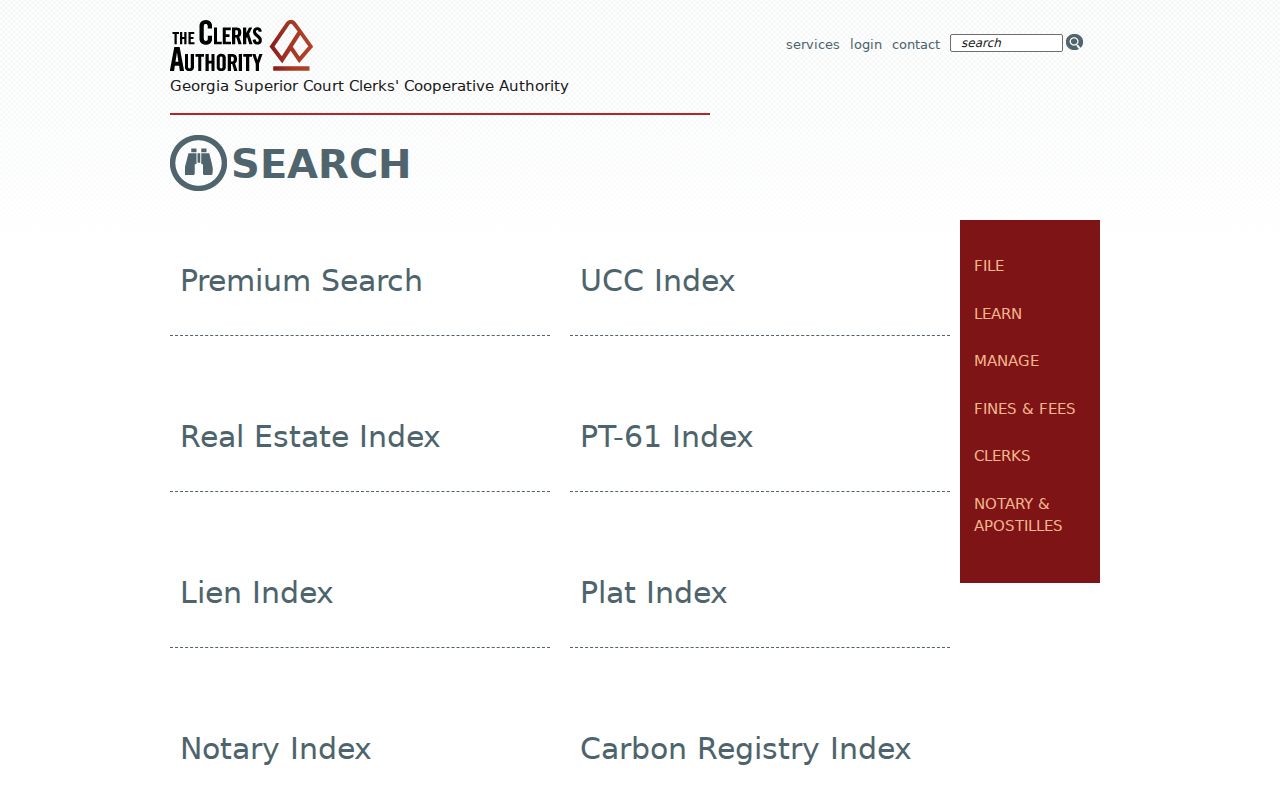
Use the index to capture party roles, instrument type, recording date, book and page, and instrument number before moving to the actual document.
| Search control | How it narrows a Georgia record | Required |
|---|---|---|
| County | Selects a participating clerk jurisdiction | Yes |
| Name | Tests a grantor, grantee, or indexed party | Usually |
| Instrument type | Limits deeds, security deeds, liens, plats, or another series | No |
| Book/Page | Retrieves a known citation directly | No |
| Date range | Reduces false matches for a common name | No |
Georgia Property Rolls Turn an Address Into a Name
Georgia does not have one statewide parcel viewer. Each county Board of Tax Assessors controls its own roll, often through QPublic, Beacon, or a local system. The Department of Revenue provides the county route. Common fields include owner name, location address, parcel number, and legal description. Results can show the owner mailing address, situs address, parcel ID, values, sales history, district, and building details.
The Georgia county property-tax directory leads to the local layer, as illustrated below. Once a parcel is found, carry its legal description and deed citation into GSCCCA or the superior-court clerk’s index.
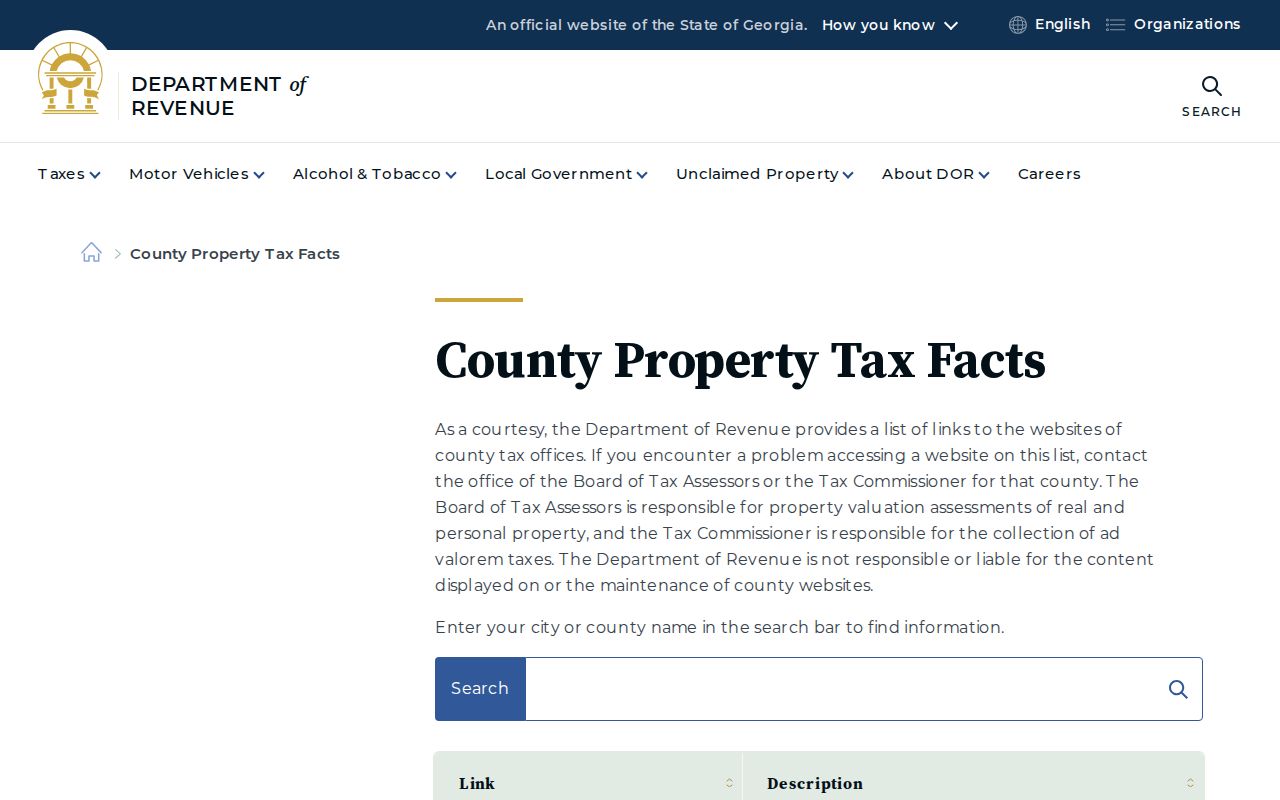
County links matter because search fields and historical depth vary. A current parcel roll can also lag a recent transfer, so confirm ownership in the recorded deed.
Note: A mailing address may point toward an absentee owner, while the situs address identifies the parcel itself.
Finding Georgia Court Records by a Person’s Name
Georgia court access depends on both county and court class. Superior courts hear felonies, divorces, land-title matters, equity, and general civil disputes. State courts commonly hear misdemeanors and civil cases where established. Magistrate, probate, municipal, and juvenile courts have separate roles, and some use different vendors or counter-only access. There is no complete, uniform statewide party-name form.
The Georgia Courts E-Access directory routes searchers to participating systems and warns that an account may be required. The page below is a routing tool, so check county coverage before treating a missing hit as meaningful.
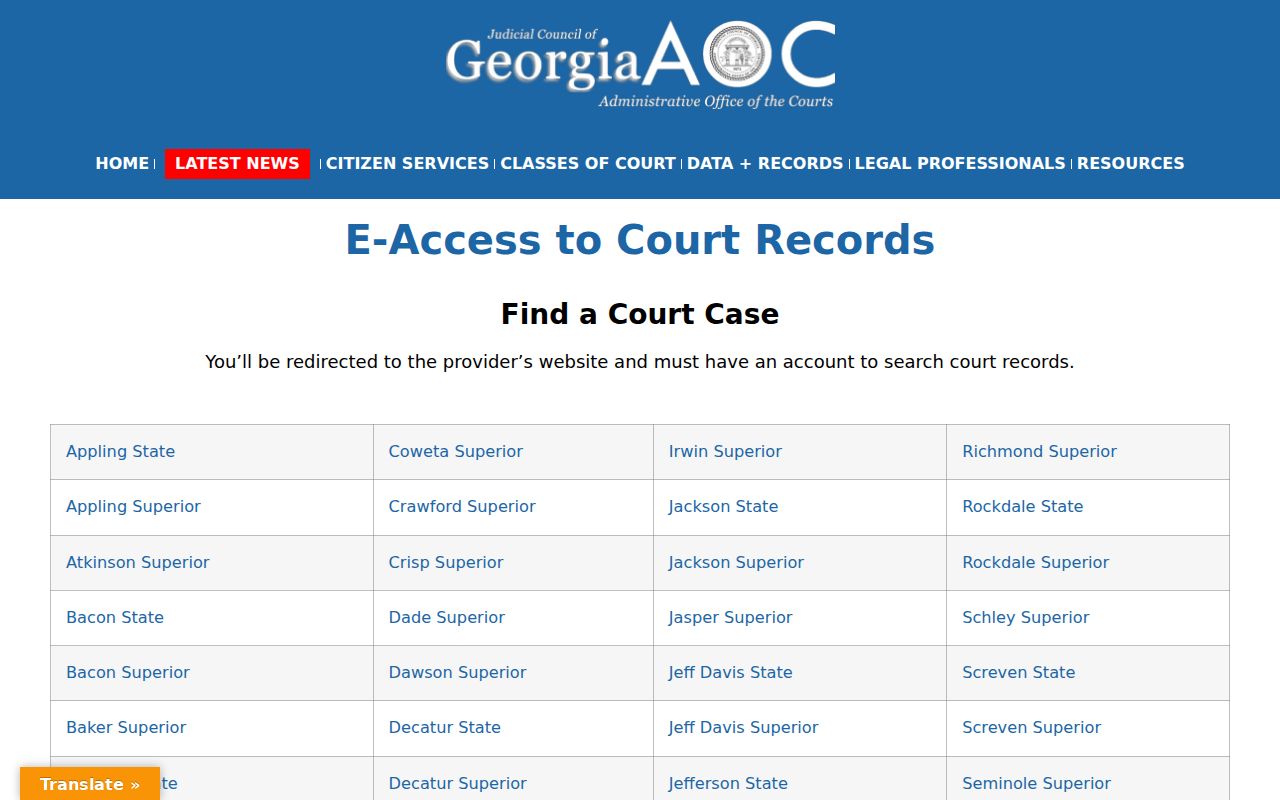
A typical docket may show the court and county, case number, style, party names and roles, attorneys, filing date, judge, status, hearings, and docket entries. Pleading images may be paid, login-gated, or available from the clerk.
| Georgia court source | Typical name-search path | Important limit |
|---|---|---|
| Superior and State courts | Provider listed through E-Access | County and vendor coverage varies |
| Magistrate, Probate, Municipal | Local clerk or separate vendor | Some records are counter-only |
| Appellate courts | State appellate docket and opinion sites | Not a trial-court file search |
| Federal courts in Georgia | PACER Case Locator | Federal schedule and access rules apply |
Note: Juvenile, adoption, sealed, and restricted filings do not become public merely because another docket entry appears online.
Georgia People Search Clues in Business and License Files
A person connected to a company or regulated occupation may appear in two distinct state systems. The Corporations Division search accepts a business name, entity type, status, registered-agent name, or control number. Results can show the legal name, formation or registration date, principal office, registered agent, status, and annual-registration history. County superior-court clerks, not the state entity database, hold local trade-name filings.
The professional licensing system can be searched by board or profession, license type, license number, personal or business name, city, and state. A result may identify a license type, number, status, issue or expiration information, and public discipline when supplied. Use the Georgia professional-license verification and compare spelling and locality with other official clues. A license or entity address may be an official contact point rather than a present home address.
Ordering and Tracing Vital Records in Georgia
Georgia DPH and county vital-record offices issue birth and death certificates. Birth certificates are restricted to eligible applicants under O.C.G.A. §§31-10-25 and 31-10-26. Death records follow DPH eligibility rules, and access to the cause of death is more restricted. Probate courts hold marriage licenses, while superior-court clerks hold divorce files. DPH also maintains marriage and divorce verification records for June 1952 through August 1996.
The official Georgia vital-record ordering page describes online, mail, and walk-in methods. The captured page below helps distinguish an order channel from a public name index.
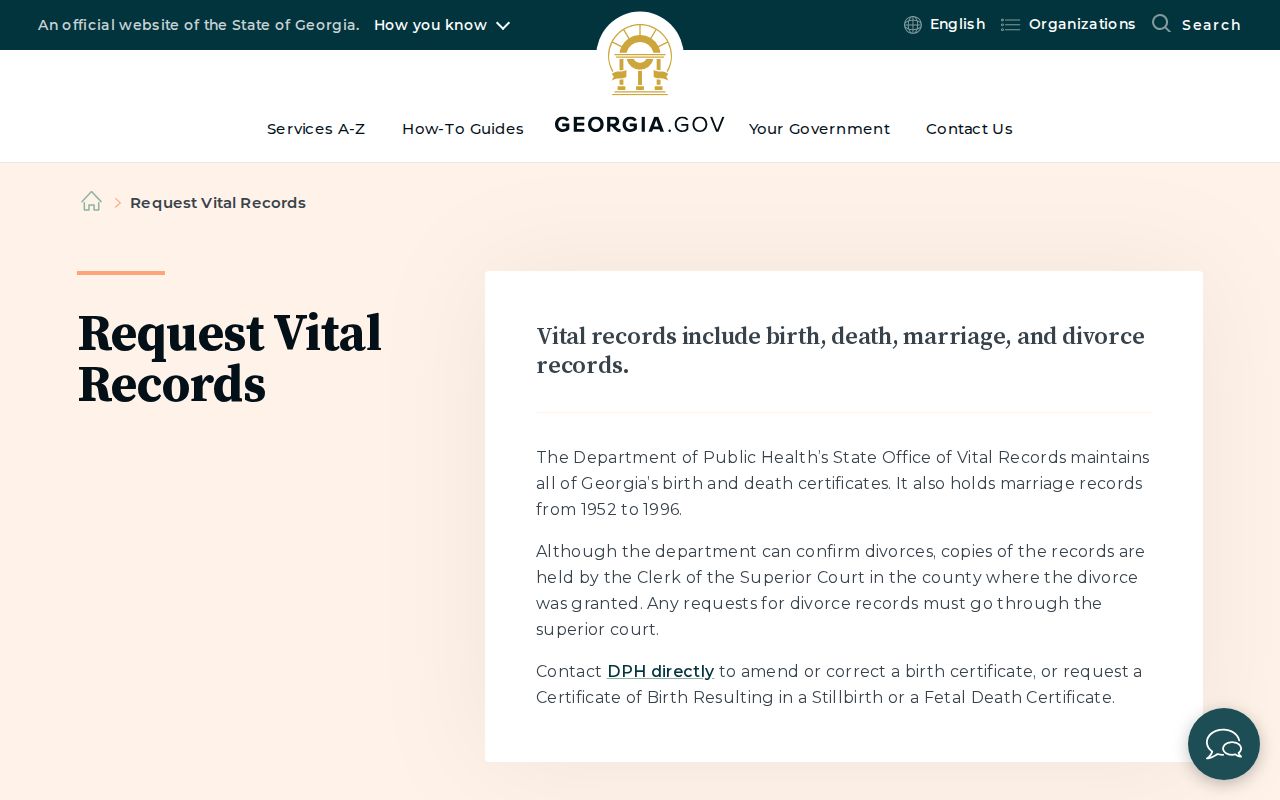
A request asks for event details, requester identity, relationship or authority, an acceptable photo ID, and payment. Online birth and death orders use ROVER or approved vendors; mail and counter options remain available. Do not mail cash.
Georgia Probate Records Create an Heir Trail
Probate files can connect relatives when a death certificate or directory provides only part of a family story. Search the probate court in the county where the estate was administered. A file may name a decedent, petitioner, executor or administrator, heirs, beneficiaries, attorneys, appraisers, and creditors, depending on the proceeding and what is public. Estate notices in the county legal organ can supply another dated clue.
Online coverage is uneven, especially for older books. If the county site has no index, contact the probate clerk with the name, approximate death or filing date, and likely county. Then check county microfilm, newspapers, cemetery files, and finding aids at the Georgia Archives. This official trail is useful for family history and estate research, but each relationship should be verified in the record rather than inferred from a shared surname.
The Georgia Archives Vault Extends a People Search
Current databases are only one layer of Georgia people search research. The Georgia Archives holds colonial, state, and county material, including maps, county microfilm, tax digests, court books, newspapers, directories, surname files, church and cemetery files, and marriage, divorce, and death index microfiche. On-site resources include licensed genealogy databases and the Atlanta Constitution for 1868 through 1984.
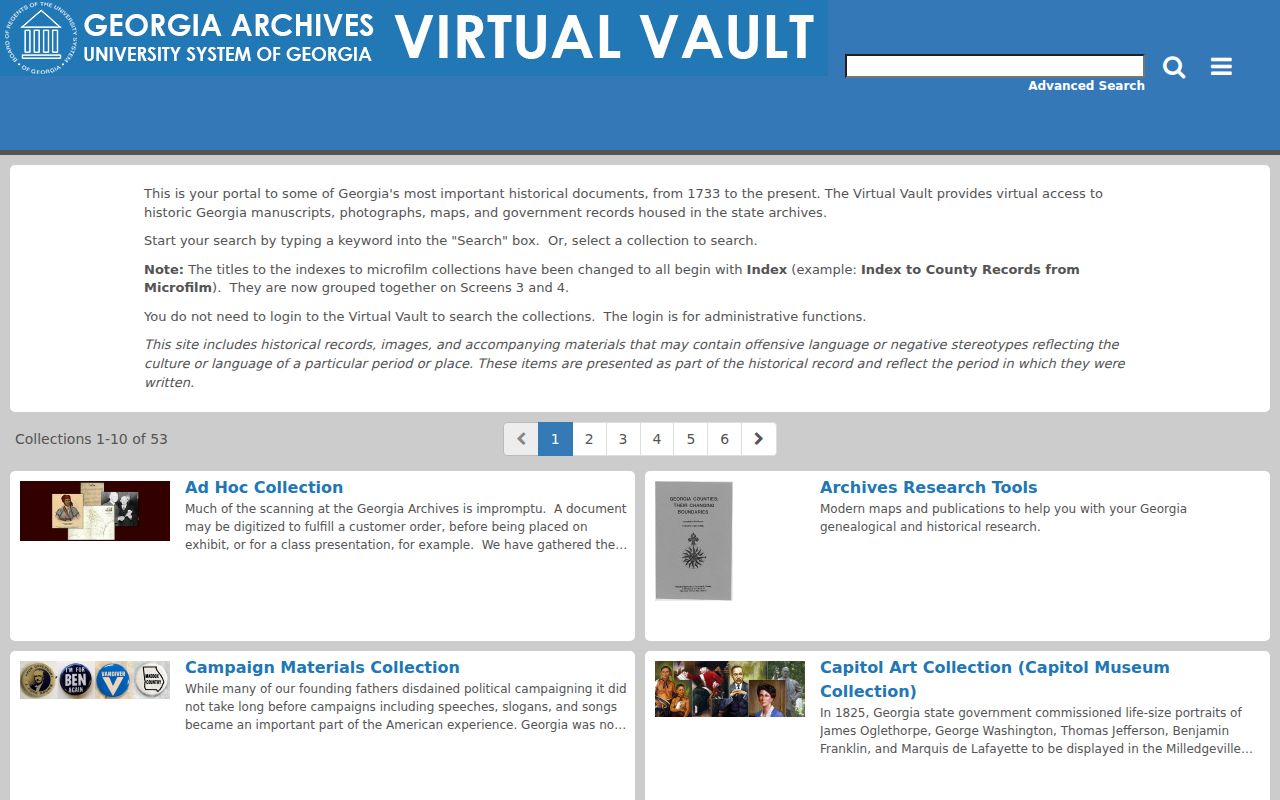
The Georgia Archives digital Vault supplies an online entry point to digitized collections. Its search surface appears below, but many useful records still require the main catalog, a finding aid, microfilm, or an on-site visit.
Search names with initials, spelling variants, married and birth surnames, counties, and time spans. Optical character recognition can miss faded type or unusual spelling, so browsing nearby newspaper pages or directory entries is often worthwhile.
Rebuilding Georgia’s Lost Early Census Clues
Georgia’s Archives census guide turns a major records gap into a research method. Many early schedules did not survive, and the 1820 schedules for Franklin, Rabun, and Twiggs are missing. The Archives identifies surviving state or county-authorized censuses from scattered years and explains how other record types can substitute for a lost population list.
For the missing 1790 census, researchers used wills, deeds, tax digests, court minutes, voter lists, and newspapers to reconstruct people one record at a time. That is also a sound modern Georgia people search habit: no one index should carry the full conclusion. A tax entry can place a name in a county; a deed can add associates and land; probate can establish family roles; and a newspaper can supply dates and context. Each source answers a different question.
Note: A gap in one Georgia series calls for a new source and custodian, not a guess.
Reconstruction Records Name Black Georgians in Detail
The 1867 Reconstruction Registration Oath Books and Returns of Voters are unusually rich name sources at the Georgia Archives. Oath books identify a person’s name, race, date, and county. Returns can add a voter number, oath-book page, length of residence, nativity, naturalization information, and remarks. These records can help place African American Georgians in a county soon after emancipation.
Historical context is essential. Earlier records may identify enslaved people only by age and sex under an enslaver’s name. Tax digests, Freedmen’s Bureau material, plantation papers, church registers, county court files, and newspapers may bridge that gap. A modern participation list and a historical return also serve different purposes, and neither reveals how anyone voted. Search Archives catalogs and county collections with name variants, community names, and nearby associates.
Note: Historical labels reflect the source period; compare them carefully with county formation dates and the person’s known community.
Brief Georgia Voter and Directory Search Routes
My Voter Page is an identity-gated self-service tool, not an unrestricted browse-by-name directory. It asks for first initial, last name, county, and date of birth, then can show registration status, polling place, precinct, districts, sample ballot, and absentee status on a match. County registrars handle corrections and missing information. Public elector lists follow separate ordering and use rules, and the voter-registration system does not contain a permanent political-party field.
Georgia directories range from state organization and judicial rosters to university staff pages, city department lists, historical city directories, newspapers, and the Archives directory of more than 600 cultural repositories. The dedicated Georgia people directories route helps choose among those sources, while voter-file detail belongs on the Voter Registration page.
When a Georgia People Search Has No Web Result
A missing web hit does not prove that no record exists. First check spelling, initials, prior surnames, date range, county, court class, and whether the portal covers the needed year or series. An index may omit images, and a vendor may not include every court. Property ownership can lag a recorded transfer. Historical records may remain in books, microfilm, local libraries, or archive collections.
Use the fallback chain that fits the record: county counter terminal, clerk phone or mail request, designated open-records officer, library catalog and microfilm, then Georgia Archives or a local repository. Under the Georgia Open Records Act, a request should describe an existing record, names, date range, case or parcel numbers, and preferred electronic format. An agency must produce responsive public records within three business days or provide a written timetable, cost estimate, and legal basis for withholding when production cannot occur then.